


This article is part of my Tools of Oppression in Relationships series. Click here to start from the beginning.
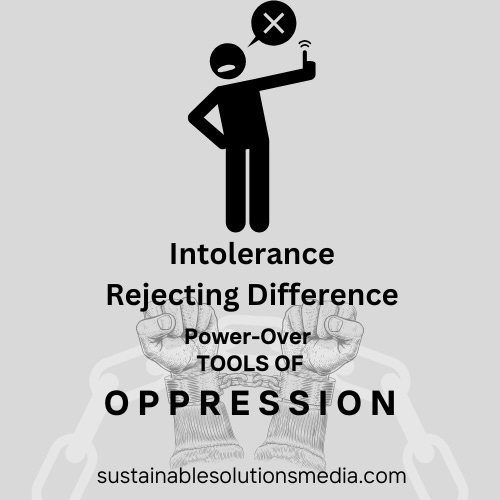
Intolerance is more than just discomfort with difference. It is the active rejection of variation of expression, identity, culture, language, appearance, and thought. As a tool of oppression, intolerance lays the groundwork for erasure and standardization, reinforcing the idea that only certain ways of being are valid while all others must be corrected, minimized, or destroyed.
From colonial conquest to cultural assimilation, intolerance has always been central to systems of oppression and domination. Colonizers did not simply take land, they imposed language, religion, gender roles, dress codes, family structures, laws, and social norms. They framed difference as deviance and justified violence through the moralizing lens of superiority. This is the true legacy of imperialism: a world where many believe that uniformity is synonymous with progress and peace and that sameness is the path to success.
The Engine Behind Erasure and Standardization
Intolerance functions as the emotional and ideological engine behind erasure and standardization. It demands not only conformity, but the disappearance of anything outside the dominant culture. What is not tolerated is rewritten, hidden, ridiculed, or forcibly removed. What is left behind is a homogenized culture that claims neutrality while violently denying context and complexity.
Over time, this leads to deeply internalized beliefs that difference is dangerous and variation is a threat. People begin to fear their own divergence, whether it be queerness, neurodiversity, cultural expression, or even emotional sensitivity. They silence themselves before others ever have to. This is how intolerance becomes self-replicating, trickling down from empire into everyday life.
Dominance Masquerading as Objectivity
This is how power sustains itself: by claiming that its way is not just a way, but the way. When someone says there is a singular standard for beauty, moral worth, language, etc., what they are often doing is parroting the preferences of those who have historically held power. And if you benefit from aligning with that power – because you are lighter-skinned, able-bodied, cisgender, educated in dominant institutions, etc. – those standards may feel objective because they have worked for you.
But dominance is not the same as objectivity. Power-Over normalizes itself so thoroughly that anything outside it seems radical, messy, or lesser. Learning to speak a certain way to be taken seriously does not put one on a higher moral ground or make one the hardest-working; it just means that one has adapted to a dominant norm that punished one’s origins. The values that are uplifted are not inherently oppressive. But when we assert that there is only one correct expression of those values, we cross into intolerance. And when that intolerance is so well-integrated that we mistake it for common sense, it becomes nearly impossible to imagine another way. That’s not objectivity; it is the murder of imagination.
Pathologizing Difference
Modern systems have become increasingly adept at disguising intolerance as care. One of the ways this shows up is through the pathologization of human variation. In a society built on standardization, dominance, and control, any deviation from the “norm” is not only discouraged, it’s medicalized, labeled, and treated as a disorder.
This surge in pathologizing behaviors, emotions, and thought patterns that don’t conform to dominant expectations and systems is not a sign of growing awareness or compassion. It is a deepening of intolerance. Rather than recognizing that different people simply need different environments, rhythms, and ways of being, we pathologize them for not adapting to systems that were never designed with their well-being in mind.
“Neurodiverse” is a more accurate and liberatory term than “neurodivergent.” “Divergent” implies there is a central “right” way of being, and anything that veers from it is off-course. “Diverse,” on the other hand, honors the full range of cognitive and sensory experiences as natural variations of being human.
But society doesn’t make room for that diversity – it disciplines it. Children who struggle to sit still in rigid classrooms are labeled as disordered. Adults who need more rest, silence, or spaciousness than capitalism allows are deemed unproductive or dysfunctional. Emotional sensitivity, nonlinear thinking, or atypical communication styles are not seen as expressions of humanity, but as pathologies to be fixed.
And once difference is framed as dysfunction, capitalism steps in to offer the cure. Rather than interrogating the systems that create the distress, we are sold solutions to make us more tolerable to them. Medications are not prescribed for healing, but for compliance – helping people fit into rigid work schedules, standardized education, and emotionally disconnected relationships. Therapy, too, is increasingly commodified, often focused not on liberation but on adaptation: how to cope, how to be productive, how to meet the standard.
Capitalism creates the conditions that make people unwell, then turns around and sells them the cure. It pathologizes natural human variation, declares it a problem, and then profits from medicating, treating, or “fixing” it. The dominant systems demand that we conform to environments they have made intolerable, and when we can’t, it offers solutions that make us more palatable to the very structures harming us. In this way, capitalism positions itself as both the arsonist and the firefighter.
Capitalism does not ask what you need; it asks how you can be made useful. The moment your difference becomes inconvenient to profit, it becomes a marketable flaw. And in that transaction, your humanity is reduced to a problem to be solved rather than a truth to be honored.
This framing is grounded deeply in intolerance. It is the refusal to accommodate or value difference unless it can be “corrected” to fit dominant molds and meet the needs of dominant systems. It places the burden of adaptation on the individual rather than on the system. But people are not broken. Our systems are.
Until we move away from the idea that deviation equals disorder, we will continue to think that healing means contorting our true selves. True care begins not with categorizing and correcting difference, but with questioning the environments that cause suffering in the first place.
Intolerance does not always look like hate or aggression. Sometimes, it looks like a diagnosis.
Intolerance in Relationships and Community
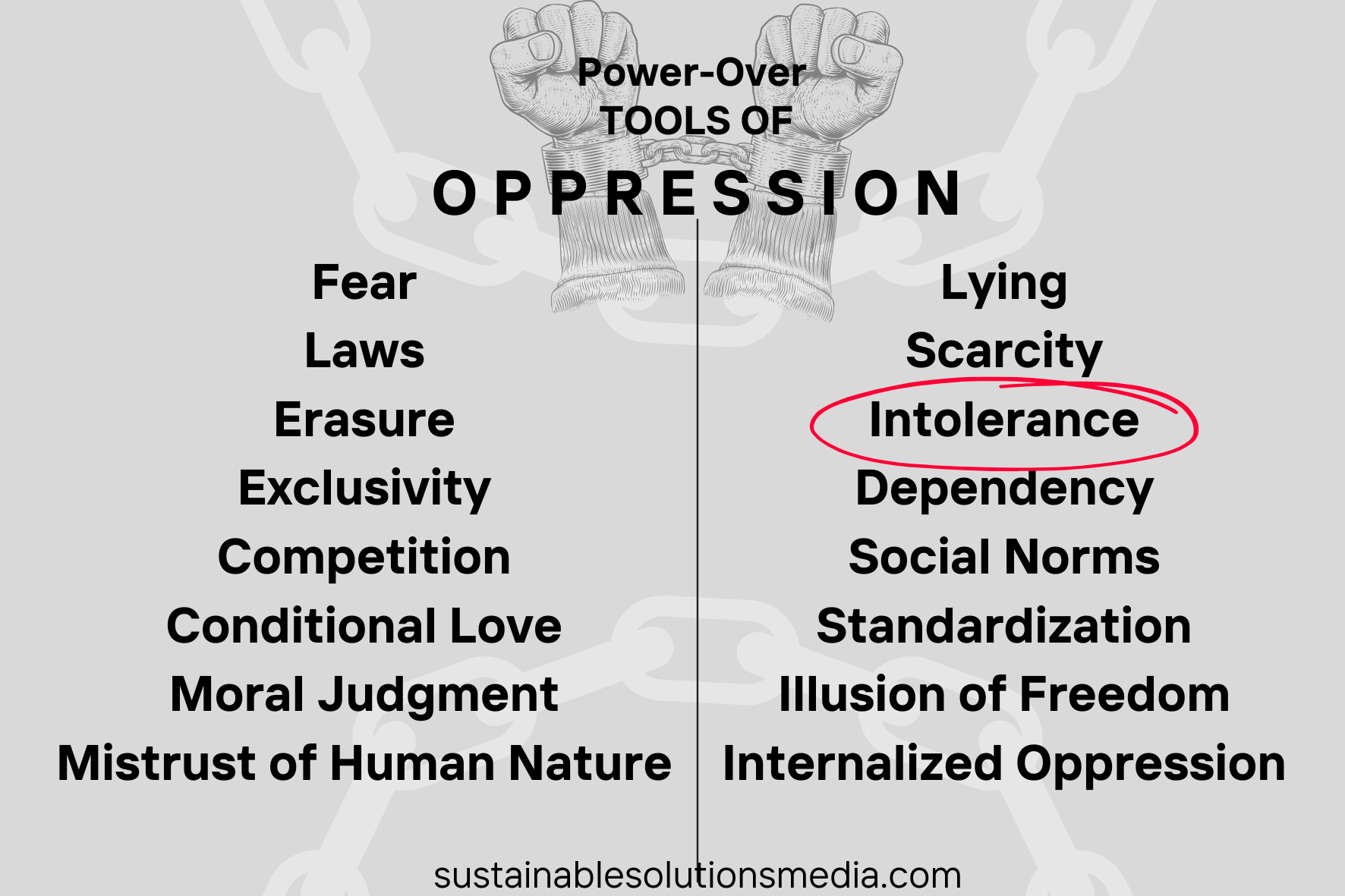
This framework doesn’t stop at the workplace or the classroom, it seeps into our relationships. When people have been conditioned to believe that their differences are deficits, they carry that belief into intimacy. They apologize for needing too much rest, for processing slowly, for reacting strongly. They minimize their needs in friendships, contort themselves in romance, and suppress parts of their identity to be seen as “low maintenance,” “easygoing,” or “normal.”
At the same time, they may pathologize others whose ways of being feel unfamiliar. A partner who needs space is labeled avoidant. A friend who is emotionally expressive is dismissed as dramatic. If someone doesn’t want the traditional nuclear family arc, they are seen as unstable or unserious. If someone needs more fluidity or complexity in their relationships, they are labeled as selfish or confused. The language of diagnosis becomes shorthand for intolerance, an attempt to categorize and correct instead of understand and relate. Relationships begin to mirror the same systems we live under: high expectations, low tolerance for variance, and a constant push to standardize and mold one another into more “acceptable” forms.
But true connection cannot thrive under the pressure to conform. The more we force each other into narrow definitions of what is reasonable, functional, or acceptable, the more we alienate the fullness of who we are. Relational freedom begins with rejecting the idea that love and compatibility depend on standardization. Different people need different things, not because they are broken, but because they are human.
The Most Devastating Intolerance: Of Self
Intolerance is easily internalized. People begin to reject parts of themselves before anyone else has to. A child taught that their natural way of speaking is uneducated, that their emotional needs are too much, or that their gender expression is shameful learns not only to suppress these traits, but to feel disgust or shame toward them. This self-directed intolerance leads to a chronic discomfort with our own difference, fluidity, and complexity.
This intolerance of self might sounds like:
Why can’t I just be normal?
I always mess things up.
If I were more _______, my life would be better.
These are not simply negative thoughts. They are artifacts of a culture that has conditioned us to conform by punishing deviation, and we do it internally.
Intolerance of self is tied to survival. When marginalized people endure repeated messaging that difference is dangerous, we learn to suppress what might put us at risk. We police ourselves before the oppressive systems around us can. This is often described as self-doubt, perfectionism, or imposter syndrome, but really, it’s a defense mechanism against systemic intolerance.
What begins as protection becomes a prison. We stop trusting our own instincts. We minimize our joy. We second-guess ourselves. We try to preempt rejection by rejecting ourselves first. We oppress ourselves. Internalized oppression is deeply tied to intolerance. It leads people to believe that their suffering is deserved because of who they are. It teaches people to “rise above” their communities instead of asking why those communities were devalued in the first place.
To move toward liberation, it is so important to reject the myth that there is a singular, superior way to live, speak, love, think, or appear. That myth has only ever served those in power. We must resist the idea that respecting individuality leads to chaos. The true danger is not difference, it is dominance masquerading as objectivity.
Most importantly, we must unlearn our intolerance of ourselves. Liberation begins not with fitting in, but with embracing our full selves, especially the parts we were taught to silence.
From Intolerance to Compassionate Liberation
If we are to ever overcome intolerance in the world around us, we must begin by confronting the intolerance we hold within. Power-Over systems succeed not only by dividing us from each other but by turning us against ourselves – against our emotions, instincts, imperfections, and our ever-evolving identities. And because internalized oppression is so often disguised as self-discipline, moral striving, or social responsibility, many never recognize how deeply their own self-rejection runs.
But intolerance, whether directed outward or inward, is always rooted in fear. The fear of being unworthy, cast out, of being seen too clearly, and not being chosen.
We can’t expect ourselves to show compassion to others if we don’t have much for ourselves. When we judge ourselves harshly, we judge others harshly. When we feel unsafe to be vulnerable, we are more likely to criticize vulnerability in those around us. Shame is not contained within us, it spills over. Tolerance of self is the ground from which liberation grows.
The ability to offer empathy to others begins with learning to sit with our own complexity. Many people think empathy is about being good but it’s not. It’s about being human. When we reject our own humanness – our mistakes, contradictions, longings, wounds – we build walls that keep us from connecting, both with ourselves and with others.
Fluidity is Not Failure
People change. The idea that we must be consistent and predictable to be trusted or respected does not respect our growth. Preferences evolve as we learn. Identities unfold. Life is dynamic. Tolerating ourselves means making room for that movement without shame or apology. This kind of internal spaciousness is what makes us able to hold space for the evolving nature of others.
Self-Trust > Self-Control
Control is a hallmark of oppression. When we use it on ourselves, we reinforce the systems that we are trying to dismantle. Self-trust, on the other hand, is expansive. It allows for rest, pleasure, and boundaries. It opens the door to a more intuitive and responsive life, one where tolerance of self makes room for connection, creativity, and truth.
Healing Requires Belonging
Much of our self-intolerance was learned through rejection, ridicule, and conditional love. Healing can’t happen through sheer willpower. It must be relational. We heal when we are witnessed in our truth and are still embraced. Overcoming intolerance means building or finding spaces where authenticity is not a liability but a gift. It means giving ourselves what Power-Over systems have long denied us: the permission to be whole.
Very powerful! Yes, they have turned everything that falls outside the acceptable norm into a disease, disorder, or mental illness and then they allow you to pay for the "cure".